File your taxes and complete your audit in one dashboard
Flex combines tax experts with AI assistance to organise your records and generate filing-ready tax documents

Over 5,000 Nigerian businesses already trust Flex to manage their spending. Flex Tax brings tax and audit into the same system.















New tax laws in Nigeria require proper filings and audited statements, yet many businesses struggle due to poor records, high costs, manual processes, and penalty risks.
Flex Tax was created to solve this.

Audit Reporting

Tax Filing

Tax filing and report generation at a lower cost and zero stress.

Standardized audit reports built to meet FIRS/NRS requirements.

AI-assisted audits reviewed and validated by certified tax experts.
Your Flex account already contains structured spend data. That means tax and audit services are faster and more affordable.
Small businesses that want to automate tax filing using their Flex data
₦20,000/month
Billed monthly
Businesses that want full support, from tax filing to audit preparation
₦50,000/month
Billed monthly
You’ll upload your own receipts and bank statements. We help organize your records and prepare your filings, which takes more time, so it costs more.
Businesses not yet on Flex but want automated help with tax filing
₦35,000/month
Billed monthly
Businesses that want complete tax and audit support even without using Flex
₦85,000/month
Billed monthly
Doing it the Old way

With Flex Tax (New Way)

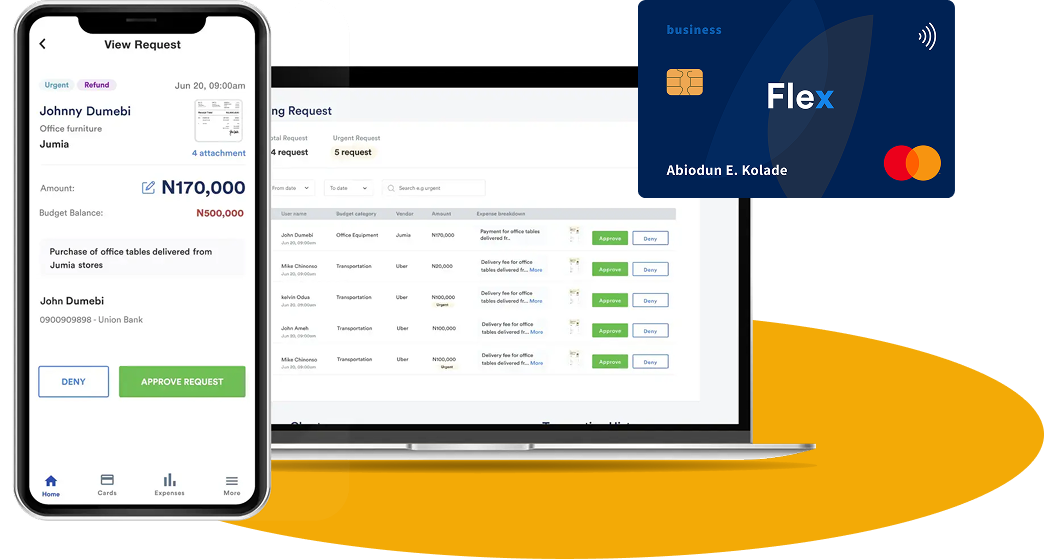
Flex Tax is a managed tax compliance and audit readiness service for Nigerian businesses that combines AI-powered financial analysis with experienced tax professionals.
The service uses automation to classify, reconcile, and structure business records, while tax experts review and validate the outputs to produce regulator-ready documentation commonly requested during tax filings and audits.
Flex Tax exists because many Nigerian businesses struggle with manual records, high audit costs, and increasing compliance pressure. By combining technology and expert oversight, Flex Tax delivers faster, more affordable, and defensible tax documentation.
Flex Tax is built strictly for registered businesses in Nigeria that are required to comply with tax regulations by the FIRS/NRS, including SMEs and growing companies that file returns or respond to tax reviews from federal or state authorities.
Flex Tax supports preparation and documentation
for key business taxes in Nigeria, including:
- Company Income Tax preparation support
- Supporting documents requested during tax
audits
and reviews
Outputs are structured to align with requirements commonly requested by Federal Inland Revenue Service and state revenue authorities such as the Nigeria Revenue Service.
Flex Tax helps businesses prepare and stay compliant through a combination of AI and tax experts.
AI is used to analyze transactions, reconcile records, and structure financial data at scale. Tax professionals then review, validate, and finalize the documentation to ensure it aligns with regulatory expectations.
Flex Tax does not act as a tax authority or file taxes directly. Instead, it delivers expert-reviewed, regulator-ready outputs that accountants or consultants can confidently submit to the Federal Inland Revenue Service or relevant state revenue services.
For VAT filings and reviews, the Federal Inland
Revenue Service typically requires businesses to
present a complete trail showing how VAT was
charged, paid, and reported. This usually
includes:
- Sales invoices indicating VAT charged
- Purchase invoices showing VAT paid and claimed
- Transaction and payment records that support
those invoices
- Monthly VAT schedules submitted for the period
under review
- Supporting documents such as receipts,
contracts, and bank evidence
Flex Tax handles this as a service by combining automated transaction structuring with expert tax review. Instead of leaving businesses to manually assemble these records, Flex Tax consolidates transaction data already flowing through the Flex platform, validates it, and prepares VAT-ready documentation that aligns with what FIRS expects during reviews or audits.
This reduces back-and-forth with FIRS and lowers the risk of rejected schedules or follow-up queries.
During withholding tax reviews, tax authorities
typically request:
- Vendor invoices
- Applicable withholding tax rates
- Proof of payment
- Beneficiary details
- Withholding tax schedules for the review
period
Flex Tax keeps vendor payments traceable and classified, making these schedules easier to generate and defend.
Yes.
A Tax Identification Number is mandatory for engaging with FIRS or state revenue services on VAT, withholding tax, and company income tax matters.
Flex Tax does not issue TINs, but it helps businesses maintain organized records linked to their registered TIN.
How do I get a Tax Identification Number (TIN) for my business? A: For most new businesses, your TIN is automatically generated by the Corporate Affairs Commission (CAC) immediately upon incorporation. You can check if you already have one by entering your RC Number at the FIRS Verification Portal.
If a TIN was not automatically assigned, you can
apply for free using one of these two methods:
- Online: Register via the Joint Tax Board at
tin.jtb.gov.ng.
- In-Person: Visit the nearest FIRS Tax Office
with your Certificate of Incorporation and a
company utility bill.
Link to the info -
-
https://firmusnigeria.com/tax-identification-number-in-nigeria/
-
https://youtu.be/caxwdR77giw
Yes
Flex Tax is designed to support both Flex users and non-Flex users.
For Flex users, the service works with transaction data already flowing through the Flex platform and applies AI and expert review to identify gaps, normalize records, and prepare clean financial documentation.
Link to the info -
-
https://firmusnigeria.com/tax-identification-number-in-nigeria/
-
https://youtu.be/caxwdR77giw
Yes
Flex Tax supports audit readiness for both Flex and non-Flex businesses.
For Flex users, the service builds on structured transaction data already captured through controlled spending and approvals, then applies expert tax review to generate standardized audit documentation.
For non-Flex users, Flex Tax ingests uploaded records, applies AI-driven reconciliation, and layers Tax expert validation to produce defensible audit outputs.
This ensures businesses can respond faster, with less disruption, and with greater confidence when audits or information requests come from FIRS or state revenue services.
Tax enforcement in Nigeria is increasing, with more businesses required to submit audited financial statements and defend their records during regulatory reviews.
Many businesses struggle because their financial data is spread across bank statements, spreadsheets, and informal approval processes. Flex solves this at the root by controlling spend before it happens through its spend management platformand completing the lifecycle with Flex Tax
Flex Tax turns day-to-day business spending into structured, transparent, and audit-ready financial records, reviewed by experts and aligned with regulatory expectations from FIRS and state revenue services.
Flex Tax reduces penalties by preventing the root causes of non-compliance.
By enforcing approval workflows, budgets, and documentation at the point of spending, through Flex spend management, ensures that records are complete and traceable. Flex Tax then applies automated classification and expert review to produce accurate, timely tax documentation.
This reduces late filings, missing records, and audit disputes, which are common triggers for penalties and fines during FIRS reviews.
Yes.
Flex Tax supports audited financial statement preparation for both Flex and non-Flex businesses.
For Flex users, the service leverages structured transaction data already available on the platform.
For non-Flex users, financial records are uploaded and standardized using AI before being reviewed by tax and audit professionals.
In both cases, Flex Tax delivers clean, standardized, and reviewed financial data that significantly reduces the time, cost, and friction involved in producing audited financial statements, without issuing audit opinions itself.
Manual bookkeeping relies on after-the-fact data collection and reconciliation, which is slow, error-prone, and difficult to defend during audits.
Flex replaces this with a system where spending is controlled, approved, and documented in real time. Flex Tax then completes the process by applying automation and expert review to generate regulator-ready outputs.
The result is faster audits, lower compliance costs, and far stronger audit defensibility than spreadsheets or ad-hoc bookkeeping.
No
Flex Tax is most valuable before tax filing season. Because it works continuously on top of the Flex platform, businesses remain audit ready throughout the year.
Instead of scrambling to clean records when FIRS deadlines or audit notices arrive, businesses using Flex Tax already have structured, reviewed financial data ready for submission or review.
Most businesses assume they are compliant because they file returns, but compliance also depends on whether records are complete, accurate, and defensible during reviews.
Tax authorities like the Federal Inland Revenue Service assess not just filings, but the underlying documentation. Flex Tax helps businesses assess readiness by structuring records, validating data through AI, and applying expert review so gaps are identified early.
Businesses should always be able to produce invoices, payment records, tax schedules, and clear transaction trails.
Flex Tax helps maintain this readiness by continuously organizing records and preparing standardized documentation that aligns with what FIRS and state revenue authorities typically request.
Bookkeeping focuses on recording transactions.
Tax readiness focuses on whether those records can withstand regulatory review.
Flex Tax goes beyond bookkeeping by transforming records into audit-ready, regulator-aligned documentation reviewed by tax professionals.
Missing documents delay filings and increase audit risk.
Flex Tax helps prevent this by continuously organizing records and, where gaps exist, reconstructing data through AI reconciliation and expert validation.
Audit costs increase when records are incomplete or unclear.
Flex Tax lowers audit costs by delivering clean, standardized, expert-reviewed documentation that reduces back-and-forth during reviews.