


Expense management software helps businesses control how money is requested, approved, spent, reimbursed, documented, and reported.
For Nigerian finance teams, this is no longer a small administrative issue.
As a business grows, more people spend company money.
Employees request funds.
Managers approve expenses.
Vendors need to be paid.
Teams need budgets.
Branches need operating funds.
Staff submit reimbursements.
Receipts arrive late.
Accountants chase context at month-end.
Leadership wants visibility before the report is ready.
That is why expense management software matters.
It is not just about tracking expenses after money has been spent.
It is about controlling the full journey of business spend:
Request → Approval → Disbursement → Receipt → Reimbursement → Record → Report
This is where Flex Finance fits.
Flex Finance helps Nigerian businesses manage expense requests, approvals, disbursements, reimbursements, vendor payments, expense accounts, corporate cards, receipts, and audit trails in one place.
For some businesses, using Flex alone would already move them into a higher level of financial discipline.
For larger businesses, Flex becomes the spend management layer that makes accounting software, ERP, and finance reporting stronger.
Because the quality of your financial records depends on the quality of your spending process.
What is expense management software?
Expense management software is a system that helps businesses manage how company money is spent.
A good expense management system should help finance teams:
- Receive expense requests
- Route approvals
- Disburse funds
- Pay vendors
- Issue cards
- Manage employee reimbursements
- Track department or branch spending
- Collect receipts and invoices
- Keep audit trails
- Prepare cleaner records for accounting and reporting
The goal is simple:
Every business expense should be approved, documented, traceable, and easy to explain.
That is what separates expense management from ordinary expense tracking.
Expense tracking tells you what happened.
Expense management helps you control what happens before and after money leaves.
Why expense management matters for Nigerian businesses
Many Nigerian businesses do not have a revenue problem only.
They have a visibility problem.
Money leaves the business every day, but the full story behind each transaction is often scattered.
One part is on WhatsApp.
One part is in email.
One part is in a bank app.
One part is in a spreadsheet.
One part is with the employee who promised to send the receipt.
One part is with the accountant trying to close the month.
This creates unnecessary stress for finance teams.
It also weakens business control.
A business should be able to answer simple questions quickly:
- Who requested this expense?
- Who approved it?
- What was it for?
- Which department owns it?
- Was it within budget?
- Has it been paid?
- Where is the receipt?
- Was it reimbursed?
- Can we explain this transaction six months from now?
If the answer is not clear, the business needs better expense management.
That is why Flex Finance is important.
Flex helps businesses bring requests, approvals, disbursements, receipts, reimbursements, vendor payments, cards, and expense accounts into one finance workflow.
Expense management vs expense tracking
Expense tracking and expense management are related, but they are not the same thing.
Spend control and clean records
A business that only tracks expenses may still have weak control.
A business that manages expenses properly controls the process from the beginning.
That is the difference Flex Finance gives.
Flex does not wait until the money is gone.
Flex helps structure the journey before the expense becomes a problem for accounting.
The common expense management problems Nigerian finance teams face
Expense management problems usually start small.
At first, the founder approves expenses personally.
Then more people join.
A team lead needs to approve requests.
A branch manager needs operating funds.
A salesperson needs transport money.
A vendor needs urgent payment.
An employee pays out of pocket and asks for reimbursement.
The accountant asks for receipts later.
As the business grows, the old system starts to show cracks.
1. Approvals happen informally
Many businesses approve expenses through WhatsApp, email, phone calls, or verbal conversations.
This may feel fast, but it creates weak records.
When finance later asks who approved the payment, the answer may be buried in a chat thread or dependent on memory.
A good expense management system should keep approval history attached to the transaction.
2. Finance pays without full context
A payment request may say “vendor payment” or “operations expense,” but finance needs more than that.
Finance needs to know:
- Why the payment is needed
- Who requested it
- Who approved it
- Which budget it belongs to
- Which invoice supports it
- Whether the vendor details are correct
Without this context, finance becomes a payment desk instead of a control function.
3. Receipts arrive late
Receipt chasing is one of the biggest hidden costs in finance operations.
It takes time.
It delays reconciliation.
It creates tension with employees.
It makes month-end close harder.
The better approach is to connect the receipt to the expense workflow from the beginning.
4. Reimbursements are slow
Employees often spend personal money on behalf of the business.
Then they submit receipts, wait for approval, follow up with finance, and sometimes wait days or weeks for repayment.
This creates frustration.
A structured reimbursement workflow makes the process clearer for employees and easier for finance.
5. Department spending is unclear
As more teams spend, leadership needs visibility by department, branch, project, location, or budget owner.
Without this, finance only sees totals.
But totals are not enough.
A business needs to know which teams are spending, what they are spending on, and whether the spend supports business priorities.
6. Vendor payments are not properly documented
Vendor payments should not be treated as ordinary transfers.
Every vendor payment should have context:
- Vendor name
- Invoice
- Service or product supplied
- Approval
- Payment proof
- Department or project owner
- Supporting documents
Without this, vendor spend becomes difficult to verify later.
7. Month-end close becomes stressful
When approvals, receipts, disbursements, and records are scattered, accountants must reconstruct the story after the fact.
This creates late nights, repeated follow-ups, delayed reports, and weak confidence in the numbers.
The problem is not the accountant.
The problem is the expense workflow.
What a good expense management system should do
A strong expense management system should not only record transactions.
It should improve how the business spends money.
Here are the core features Nigerian finance teams should look for.
1. Expense requests
Employees and teams should be able to submit expense requests clearly.
A good request should include:
- Amount
- Purpose
- Category
- Department or branch
- Supporting invoice or document
- Preferred payment method
- Required approval
This gives finance the context before money leaves.
2. Approval workflows
Approvals should follow clear rules.
For example:
- Small expenses may need one manager
- Larger expenses may need finance approval
- Department expenses may need the department head
- Capital expenses may need executive approval
- Vendor payments may need both operations and finance review
A good system should support approval workflows that match how the business actually works.
3. Disbursements
After approval, the business should be able to disburse funds in a controlled way.
This reduces the gap between approval and payment.
The stronger the link between approval and disbursement, the easier it is to trace what happened.
4. Employee reimbursements
Employees should have a clear way to submit reimbursement claims.
Finance should be able to review, approve, pay, and document reimbursements without losing context.
This is especially useful for sales teams, field teams, travel expenses, logistics, and operations.
5. Vendor payments
Vendor payments should be tied to approval, invoice, business purpose, and payment proof.
This helps finance teams avoid confusion and keep supplier records cleaner.
6. Expense accounts
Businesses should be able to create dedicated expense accounts for teams, branches, departments, projects, or locations.
This makes it easier to control spend by business unit.
For example:
- Marketing expense account
- Operations expense account
- Sales expense account
- Abuja branch expense account
- Lagos field team expense account
- Project-specific expense account
Expense accounts help finance teams see spending behavior more clearly.
7. Corporate cards
Corporate cards help businesses give employees or teams controlled access to company funds.
The key is not just issuing cards.
The key is setting limits, tracking usage, attaching receipts, and keeping card spend visible.
8. Receipt and invoice capture
Every expense should have evidence.
A strong system should make it easy to attach invoices, receipts, and supporting documents to the transaction.
This helps accountants avoid chasing documents later.
9. Audit trails
Every transaction should carry its own history.
The system should show:
- Who requested it
- Who approved it
- When it was approved
- How it was paid
- Which receipt or invoice was attached
- Which team or project owns it
This is what makes expenses easier to explain.
10. Reporting and visibility
Finance teams need to see spend clearly.
Leadership should be able to understand:
- Total spend
- Spend by team
- Spend by branch
- Spend by category
- Pending approvals
- Reimbursements
- Vendor payments
- Card usage
- Expense trends
Good expense management gives finance visibility before the end of the month.
Why Flex Finance is built for expense management in Nigeria
Flex Finance is built around the realities of Nigerian business spending.
Many businesses do not only need a place to record expenses.
They need a system that helps them manage how expenses happen.
Flex helps finance teams move from scattered spending to structured spend control.
With Flex, businesses can manage:
- Requests
- Approvals
- Disbursements
- Reimbursements
- Vendor payments
- Expense accounts
- Corporate cards
- Receipts
- Audit trails
- Spend visibility
That makes Flex useful for finance teams, founders, accountants, COOs, branch managers, department heads, and growing businesses.
The strongest way to think about Flex is this:
Flex Finance is the spend management layer before accounting.
Accounting software records what happened.
Flex helps make sure what happened was approved, documented, and easy to explain.
How Flex improves expense management
Flex gives every expense a clear beginning
Many expense problems happen because the business only sees the transaction after money has left.
Flex starts earlier.
The expense begins as a request.
That request can carry the amount, purpose, supporting document, department, project, or branch.
This gives finance context before payment happens.
Flex keeps approvals structured
Approvals should not depend on memory or scattered messages.
Flex helps businesses route approvals through a clearer workflow.
This means the business can know who approved what, when it was approved, and what was approved.
Flex connects approval to payment
A common problem in finance is the gap between approval and disbursement.
Something may be approved in one place and paid somewhere else.
Flex helps bring the flow closer together so finance has better visibility from request to payment.
Flex reduces receipt chasing
When receipts and invoices are attached to the expense record, accountants do not have to spend as much time searching for proof later.
This makes reporting and reconciliation easier.
Flex supports reimbursements
Employee reimbursements can become slow and frustrating when they are handled manually.
Flex helps create a clearer process for submitting, reviewing, approving, and paying reimbursements.
Flex supports vendor payments
Vendor payments need documentation.
Flex helps finance teams manage vendor payments with clearer approval and payment trails.
This is important for businesses that work with many suppliers, contractors, service providers, logistics partners, and operational vendors.
Flex supports expense accounts
A growing business needs to know where money is going.
Flex helps businesses organize spend by department, branch, team, project, or location.
This turns spending from a general number into useful management insight.
Flex supports corporate cards
Cards can help teams move faster, but only if they come with control.
Flex helps businesses manage card spend with better visibility and documentation.
Flex strengthens accounting
Flex is not a full accounting software.
That is not the point.
Flex makes accounting stronger by improving the quality of the transaction records before they reach the books.
The cleaner the spend workflow, the cleaner the accounting process.
Who needs expense management software?
Expense management software is useful for any business where more than one person spends company money.
It is especially useful for:
Finance teams
Finance teams need control, documentation, and visibility.
Flex helps reduce manual follow-ups and gives finance a clearer view of spending activity.
Accountants
Accountants need complete records.
Flex helps make sure expenses carry approval context, receipts, and supporting documents before month-end.
Founders and CEOs
Leadership needs visibility without managing every small expense personally.
Flex helps leaders see how money is moving without joining every approval conversation.
COOs and operations teams
Operations teams often need fast access to funds.
Flex helps them move faster while still giving finance control.
Multi-branch businesses
Branches spend money daily.
Flex helps businesses organize branch expenses, approvals, and documentation in one place.
Field teams
Field teams often need transport, logistics, procurement, or operational funds.
Flex helps make field spending more traceable.
Businesses with many vendors
Vendor payments can become messy when invoices, approvals, and payment evidence are scattered.
Flex helps make vendor payments easier to manage.
Businesses with reimbursements
Employee reimbursements need speed and clarity.
Flex helps businesses create a more consistent reimbursement process.
Signs your business needs expense management software
Your business likely needs expense management software if:
- Approvals happen on WhatsApp, email, or verbally
- Finance pays expenses without full context
- Receipts are always chased later
- Employees complain about delayed reimbursements
- Vendor payments are difficult to trace
- Branch expenses are hard to monitor
- Department spending is unclear
- Card spend lacks visibility
- Month-end close depends on manual follow-ups
- The accountant keeps asking for explanations
- Management only sees spend after reports are prepared
- You cannot quickly explain who approved a transaction and why
These are signs that the business has outgrown manual expense management.
The solution is not only to work harder.
The solution is to make the workflow better.
Expense management software vs accounting software
Accounting software and expense management software work best together.
They do different jobs.
Accounting software is important.
But if the expense workflow is weak, accounting software only receives weak records.
That is why Flex should sit before accounting.
Flex helps ensure that the spend entering accounting software is already approved, documented, and traceable.
Expense management software vs ERP
ERP connects many business functions.
Expense management focuses on how money leaves.
A business may use ERP and still need a dedicated spend management workflow.
Why?
Because daily spending needs speed and control.
ERP may connect finance to procurement, inventory, HR, sales, and operations.
But finance teams still need a clear system for:
- Requests
- Approvals
- Disbursements
- Receipts
- Reimbursements
- Vendor payments
- Cards
- Expense accounts
- Audit trails
That is where Flex fits.
ERP connects the business.
Flex controls spend.
For many businesses, Flex should come before ERP.
For larger businesses, Flex can work alongside ERP as the focused layer for daily spend management.
For some businesses, Flex alone is already a major upgrade
Not every business needs ERP immediately.
Not every business needs a complex finance stack on day one.
For many businesses, the biggest transformation is much simpler:
Can every naira leaving the business be requested, approved, paid, documented, and traced in one place?
If the answer is yes, that business is already operating with a strong level of financial discipline.
Because the foundation of strong finance is not complexity.
It is control.
A business that can clearly show who requested money, who approved it, what it was used for, how it was paid, where the receipt is, and which team or project owns the expense is already far ahead of the average company.
Even without a full ERP, that business has something powerful:
A clean spend operating system.
For some businesses, Flex Finance alone is the first major step into serious financial control.
For larger businesses, Flex becomes the spend management layer that makes accounting software and ERP stronger.
How to choose expense management software in Nigeria
When choosing expense management software, Nigerian finance teams should look beyond nice dashboards.
The system should fit how the business actually spends money.
Here are the questions to ask.
1. Can it manage requests before payment?
The system should not only record expenses after the fact.
It should help teams request money before spending happens.
2. Can it support approval workflows?
The system should allow the business to route expenses to the right approvers.
Approvals should be visible and traceable.
3. Can it handle disbursements?
After approval, finance should be able to pay or disburse funds in a controlled way.
4. Can it support reimbursements?
Employees should be able to submit reimbursement claims with receipts and explanations.
Finance should be able to approve and pay them clearly.
5. Can it manage vendor payments?
Vendor payments should include invoice, approval, payment proof, and transaction context.
6. Can it organize spend by team, branch, or project?
A growing business needs visibility beyond total spend.
The system should help finance see where money is going across the company.
7. Can it support corporate cards?
Cards should come with controls, visibility, and documentation.
8. Can it reduce receipt chasing?
The system should make it easier to attach receipts and invoices to the expense record.
9. Can it create audit trails?
Every expense should be traceable from request to approval to payment to documentation.
10. Can it work with accounting?
The system should help accounting teams receive cleaner records, even if it is not the accounting software itself.
Flex Finance is built around these needs.
That is why it is a strong expense management choice for Nigerian businesses.
Common expense categories Flex can help manage
Nigerian businesses can use Flex to manage many kinds of expenses, including:
- Vendor payments
- Staff reimbursements
- Transport expenses
- Logistics expenses
- Fuel expenses
- Office supplies
- Travel expenses
- Branch operating expenses
- Field team expenses
- Marketing expenses
- Procurement requests
- Project expenses
- Subscription payments
- Team budgets
- Emergency operational expenses
- Corporate card spending
The specific categories may vary by business.
The important thing is that every spend category should have structure.
Money should not leave the business without context.
Expense management for different Nigerian businesses
Startups
Startups need speed, but speed without records creates future problems.
Flex helps startups approve and track spend without slowing the team down.
SMEs
SMEs need better control as more people begin to spend company money.
Flex helps SMEs move from informal approvals to structured finance workflows.
Multi-branch businesses
Multi-branch businesses need visibility across locations.
Flex helps track spend by branch, team, department, or project.
Field teams
Field teams often need fast access to funds for logistics, transport, procurement, and daily operations.
Flex helps make field spending easier to approve and trace.
Professional services firms
Consulting, legal, accounting, creative, and agency businesses often manage project-related expenses.
Flex helps assign spend to the right project or client workflow.
Retail businesses
Retail businesses need to control store-level and operations-related spending.
Flex helps finance teams keep branch and operations expenses visible.
Oil, gas, logistics, and operations-heavy businesses
These businesses often deal with vendor payments, field expenses, transport, maintenance, and urgent operational spend.
Flex helps keep these expenses documented and traceable.
How Flex improves month-end close
Month-end close becomes harder when finance teams have to reconstruct spending after the fact.
The accountant may need to ask:
- Who made this payment?
- Who approved it?
- What was it for?
- Which invoice supports it?
- Has the receipt been submitted?
- Which department owns it?
- Is this reimbursable?
- Was this payment duplicated?
- Was this within budget?
Flex helps reduce this pressure by keeping the spend trail clearer from the beginning.
When requests, approvals, payments, receipts, and records are connected, month-end close becomes easier.
This does not remove the need for accounting software.
It strengthens accounting.
The accountant receives cleaner records.
Finance spends less time chasing explanations.
Leadership gets better visibility.
How to implement expense management software
A business does not need to make the process complicated.
Start with the expenses that create the most pressure.
Step 1: Map how money currently leaves
List the main spending channels:
- Vendor payments
- Employee reimbursements
- Staff advances
- Branch expenses
- Department budgets
- Corporate cards
- Operational disbursements
Step 2: Define approval rules
Decide who approves what.
For example:
- Expenses under a certain amount
- Department-level approvals
- Finance approvals
- Executive approvals
- Vendor payment approvals
- Reimbursement approvals
Step 3: Create expense categories
Organize spending into clear categories.
This helps reporting and accounting later.
Step 4: Set up teams, branches, or projects
If the business has multiple units, separate spend visibility by team, branch, department, or project.
Step 5: Move requests into Flex
Stop allowing money requests to live only in WhatsApp, email, or verbal conversations.
Move them into a structured workflow.
Step 6: Attach receipts and invoices
Make documentation part of the process.
Every expense should carry its supporting documents.
Step 7: Review reports regularly
Use expense visibility to understand spending behavior.
Finance should not only record expenses.
Finance should help the business understand how money is moving.
The best expense management setup for Nigerian finance teams
A strong setup looks like this:
Flex Finance for spend control
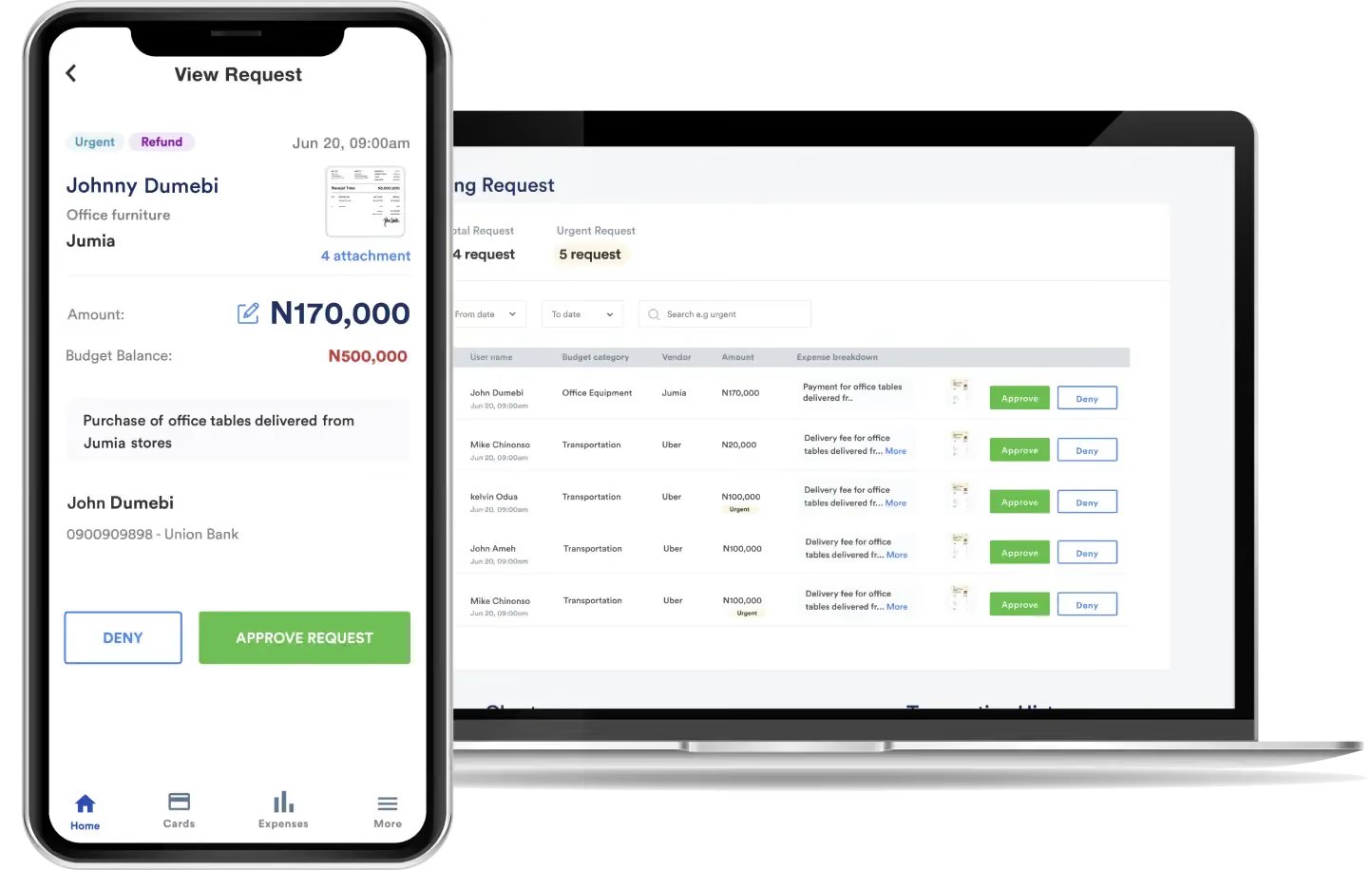
Use Flex to manage:
- Requests
- Approvals
- Disbursements
- Reimbursements
- Vendor payments
- Expense accounts
- Cards
- Receipts
- Audit trails
- Spend visibility
Accounting software for books and reports
Use accounting software to manage:
- Bookkeeping
- Reconciliation
- Financial statements
- Tax records
- Profit and loss reports
- Balance sheets
- Cash flow reports
ERP when the business needs deeper integration
Use ERP when finance needs to connect with:
- Inventory
- Procurement
- HR
- Payroll
- Sales
- Operations
- Supply chain
- Manufacturing
- Multi-department reporting
This is the better finance stack:
Flex controls spend.
Accounting software records money.
ERP connects the business.
Why Flex Finance should be the first layer
Expense management sits at the beginning of the finance journey.
Before accounting software records a transaction, someone spent the money.
Before ERP connects the process, the business needs to know how the process works.
Before leadership sees a report, finance needs clean data.
That is why Flex should sit at the front of the workflow.
Flex helps the business answer the most important spend questions early:
- Should this money leave?
- Who approved it?
- What is it for?
- How should it be paid?
- Where is the proof?
- Can it be explained later?
This is the foundation of strong finance operations.
Final recommendation
Expense management software is no longer optional for growing Nigerian businesses.
Once more people, teams, branches, vendors, and employees are involved in spending company money, the business needs structure.
Spreadsheets, WhatsApp approvals, bank transfers, delayed receipts, and manual follow-ups may work for a while.
But they do not scale well.
Flex Finance gives Nigerian businesses a better way to manage spend.
It helps finance teams control requests, approvals, disbursements, reimbursements, vendor payments, expense accounts, corporate cards, receipts, and audit trails in one workflow.
For smaller businesses, Flex alone can be the first big step into serious financial control.
For growing businesses, Flex strengthens accounting by sending cleaner expense records into the books.
For larger businesses, Flex supports ERP by keeping daily spend workflows controlled and visible.
The conclusion is simple:
If money leaves your business, Flex belongs in the workflow.
Accounting software can record the money.
ERP can connect the business.
But Flex Finance helps control the spend before it becomes a record.
That is where better finance begins.
FAQs
What is expense management software?
Expense management software helps businesses manage how money is requested, approved, spent, reimbursed, documented, and reported. It helps finance teams control expenses before and after money leaves the business.
What is the best expense management software in Nigeria?
The best expense management software in Nigeria should support local business realities such as approvals, disbursements, vendor payments, employee reimbursements, expense accounts, corporate cards, receipts, and audit trails. Flex Finance is built to help Nigerian businesses manage these workflows in one place.
Is expense management software the same as accounting software?
No. Accounting software records and reports transactions. Expense management software controls the process before transactions become accounting records.
Do I need expense management software if I already use accounting software?
Yes. Accounting software records what happened. Expense management software helps control how it happened. If your business has approvals, reimbursements, vendor payments, cards, receipts, and team spending, you need expense management alongside accounting software.
Do I need expense management software if I use ERP?
Yes. ERP connects the business, but finance teams still need a focused workflow for daily spend. Flex can support ERP by managing requests, approvals, disbursements, reimbursements, receipts, vendor payments, and audit trails.
What does Flex Finance do?
Flex Finance helps Nigerian businesses manage spend in one workflow. This includes expense requests, approvals, disbursements, reimbursements, vendor payments, expense accounts, corporate cards, receipts, payment records, and audit trails.
Who should use Flex Finance?
Flex is useful for finance teams, accountants, founders, CEOs, COOs, branch managers, department heads, field teams, and any business where multiple people spend company money.
How does Flex help with reimbursements?
Flex helps businesses create a clearer workflow for employees to submit reimbursement claims, attach receipts, get approvals, and receive payment.
How does Flex help accountants?
Flex helps accountants by keeping expense records cleaner from the beginning. Requests, approvals, receipts, payments, and audit trails are easier to trace, which makes month-end close and reconciliation easier.
How does Flex help management?
Flex gives management better visibility into how money is moving across teams, branches, departments, vendors, cards, and projects.
Why is expense management important for Nigerian businesses?
Expense management is important because many Nigerian businesses still manage spending through scattered channels. A proper system helps reduce manual follow-ups, improve visibility, control approvals, support reimbursements, and keep better finance records.
When should a business start using expense management software?
A business should start using expense management software once more than one person, team, branch, or department spends company money. The earlier the workflow is structured, the easier it is to scale finance operations.


.png)


.png)